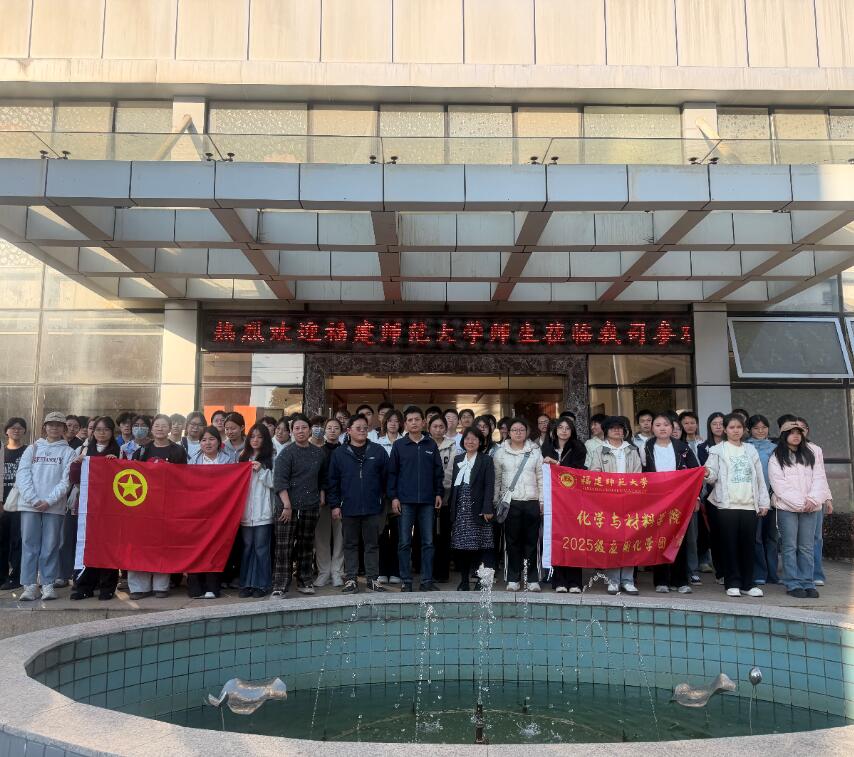
Warmly welcome Fujian Normal University Students Visit Daihei Ink
26th,Nov,2026 in Fuzhou,Daihei ink company— A delegation of students and faculty from the College of Chemistry and Materials Science at Fujian Normal University visited Daihei ink's manufacturing base in Fuzhou this week for a day of hands-on industry practice, giving the next generation of chemists and materials specialists a close-up view of how laboratory science becomes industrial products.
1.A Full Walk-Through of the Production Chain
The visit was structured to follow the company's value chain from raw material to finished goods. The group began at the product exhibition area, where the team presented the company's portfolio across sheetfed offset ink,web ink,pantone colors ink,uv ink, flexographic and specialty inks, together with stamping varnishes and related auxiliary products. Students were able to examine samples, compare colour references and understand how different ink systems are formulated for different substrates and printing processes.
The delegation then moved to the application demonstration section, where technicians walked them through real customer scenarios — packaging, labelling, publication and specialty decoration — and showed how printing parameters, curing conditions and substrate choice influence final performance. The demonstration made clear that ink is not simply a colourant but a system of resins, pigments, solvents and additives engineered to meet precise requirements for adhesion, gloss, curing speed and durability.
2.Inside the R&D Center
At the R&D center, students toured the formulation laboratory, colour-matching facilities and testing benches. Researchers explained the development cycle of a new product — from customer requirement and formulation screening to stability testing, print trials and final approval — and highlighted the analytical instruments used to verify viscosity, fineness, curing behaviour and environmental compliance. Many of the students noted that the work they saw mirrored the analytical chemistry and polymer coursework they had studied in the classroom, now applied under commercial time pressure and regulatory constraints.
3.Production and Raw Material Warehousing
The tour continued into the production center, where the group observed the full manufacturing flow: raw material weighing and dispensing, high-speed dispersion and grinding, filtration, quality inspection and automated filling and packing. The company's quality control team explained how batch records, in-process checks and finished-goods testing work together to keep output consistent.
The final stop was the raw material warehouse, where students saw how resins, pigments, solvents and packaging materials are received, inspected, stored and released under controlled conditions — a practical lesson in supply chain management and material safety that rarely appears in a textbook.
A Partnership of More Than 20 years
The relationship between Daihei ink and Fujian Normal University's College of Chemistry and Materials Science goes back nearly twenty years. Over that period the two sides have maintained regular exchanges on industry trends, formulation technology and talent development, and the company has recruited a steady stream of graduates from the college who now work across its R&D, quality and production departments.
"The students we met today are the people who will shape this industry in ten years. We want them to leave with a real picture of what our work looks like, and we want them to know there is a place for them here." said Mr Zheng,the duty general maneger of Daihei ink.
"Seeing the theory we teach translated into industrial practice is invaluable for our students. This visit strengthens a collaboration that has benefited both the university and the company for two decades." said teacher Peng, College of Chemistry and Materials Science, Fujian Normal University.
Looking Ahead
Daihei ink hope to continue and expand the cooperation — through internships, joint projects and guest lectures — as part of its long-standing commitment to university-industry collaboration. Both sides agreed that connecting classroom chemistry with factory-floor reality remains one of the most effective ways to build the talent pipeline the ink and coatings industry necessary.

 English
 zh
 Русский
 عربي
 Español
 Français







 IPv6 RED SOPORTADA
